
Views: 0 Author: Site Editor Publish Time: 2026-11-05 Origin: Site


Picture this: a newly commissioned commercial high-rise struggles with inconsistent ambient temperatures. Meanwhile, a low-frequency, disruptive hum vibrates through the executive boardroom walls. What is the culprit behind these issues? Usually, it is a mismatched blower buried deep within the mechanical room. When designing or upgrading your heating, ventilation, and air-conditioning infrastructure, selecting the right Cabinet Centrifugal Fan is arguably the most consequential engineering decision you will make. It acts as the mechanical heart of the entire network.
A poorly specified air mover inevitably leads to compromised indoor air quality, skyrocketing utility bills, and premature component failure. Meticulously chosen units, on the other hand, guarantee optimal air circulation, stringent climate control, and long-term acoustic harmony. This comprehensive guide is engineered specifically for facility managers, HVAC technicians, and building owners navigating the complex procurement stage. The following insights will provide the exact blueprint needed to optimize your mechanical room and avoid costly operational pitfalls.
The Core Driver: The enclosed blower is responsible for overcoming dense internal system resistance and delivering precise volumes of conditioned air evenly throughout a facility.
Resistance is Everything: Accurately calculating aerodynamic drag is mandatory. Underestimating it results in weak airflow, while overestimating leads to severe energy waste and noisy ducts.
Mechanical vs. Integrated Drives: Traditional pulley systems offer manual speed flexibility. Modern integrated motors provide a highly efficient, compact, and virtually maintenance-free alternative.
Aerodynamic Blade Geometry: Backward-curved impellers are the gold standard for commercial applications due to their superior efficiency and inherent non-overloading power characteristics.
Acoustic Mitigation: Strategic equipment selection minimizes structural vibration and airborne noise, drastically reducing maintenance calls and ensuring compliance with indoor environmental quality standards.
An AHU room is a dedicated, often highly restricted mechanical space. It houses the large-scale commercial equipment used to filter, thermally condition, and circulate air. Think of these environments as the respiratory system of modern hospitals, data centers, and industrial facilities. Inside the heavy steel access doors, you will find a complex labyrinth of primary and secondary filter banks, chilled water coils, heating elements, mixing dampers, and the central ventilation assembly.
The physical environment within these spaces requires heavy-duty equipment capable of withstanding continuous round-the-clock operation. Equipment must handle fluctuating thermal loads and varying humidity levels effortlessly. Because this specific unit dictates the overall indoor air quality of the occupied spaces below, every internal component must be specified based on strict empirical data rather than guesswork.
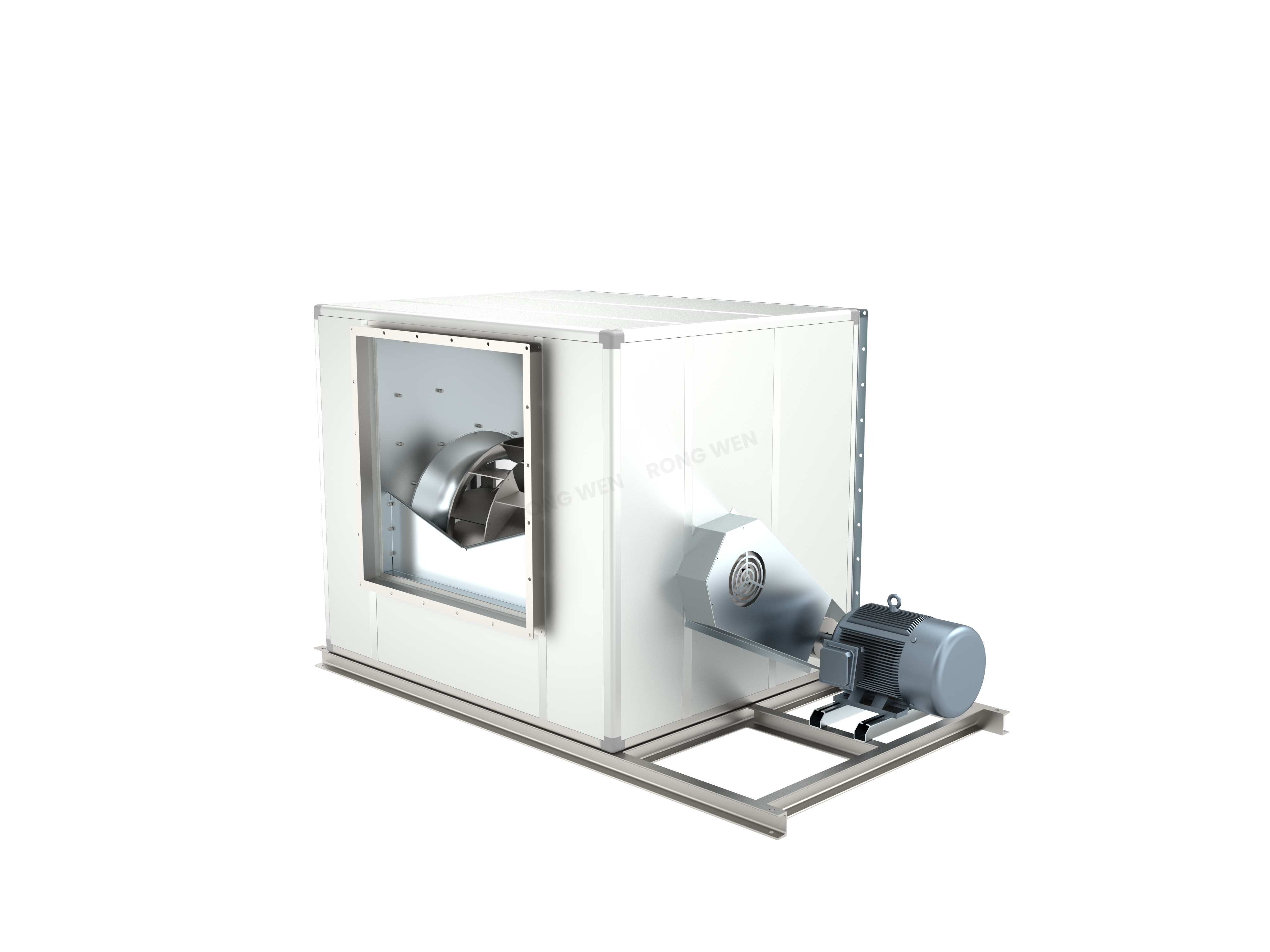
The enclosed centrifugal blower is specifically engineered to pull unconditioned return air through dense, restrictive HEPA filters and wet thermal coils. It subsequently forces the treated air out into a sprawling network of galvanized ductwork. The cabinet aspect of this machinery serves a critical functional purpose.
Constructed from double-skinned steel panels and packed with high-density mineral wool, the housing acts as a robust acoustic enclosure. This heavy insulation muffles the aggressive operational noise generated by the spinning impeller, making it suitable for noise-sensitive commercial environments. Furthermore, the structural rigidity of the cabinet prevents pressurized air leakage. This ensures that all generated airflow is directed precisely where the building management system demands it.
In the realm of fluid dynamics and HVAC engineering, Static Pressure is defined as the physical resistance to airflow within a ducted network. Imagine the aerodynamic friction the air encounters as it is violently pushed through tightly woven fiberglass filters, dense finned cooling coils, restrictive fire dampers, and the sharp elbows of the ductwork itself. This invisible force is typically measured in Pascals or inches of water gauge. Accurately capturing this metric requires specialized instruments like digital manometers during the commissioning phase.
The relationship between your chosen blower and system resistance is absolute. If the specified unit lacks the aerodynamic muscle to generate sufficient pressure, the conditioned air will simply stall before it ever reaches the farthest diffusers in your building. The immediate result is stagnant office spaces, employee complaints, and compromised temperature control.
Conversely, overcompensating by specifying a massive high-pressure fan is equally disastrous. An oversized unit will aggressively force excessive air through the ducts at high velocities. This triggers a cascade of problems including howling ceiling vents, extreme structural stress on duct seams, and unnecessarily bloated electrical consumption. Engineers must meticulously calculate the total external static pressure to ensure the fan performance curve intersects perfectly with the actual resistance curve of the building.
When finalizing your mechanical specifications, choosing the appropriate rotational drive mechanism is a critical decision. It directly dictates your facility maintenance schedule for the next decade.
A Belt Drive configuration is a legacy mechanical setup where the electric motor sits independently from the fan wheel. It transmits rotational power via a series of V-belts and iron sheaves. The primary advantage here is mechanical adjustability. If the airflow requirements of the building drastically change post-installation, technicians can physically swap out the pulleys to alter the fan speed without replacing the expensive motor.
However, this flexibility comes at a steep maintenance cost. Belts inevitably stretch, crack, and slip over time. Bearings require tedious routine lubrication. Failure to maintain laser-precise pulley alignment results in a squealing mechanical room, degraded airflow, and roughly a five percent loss in energy efficiency due to pure mechanical friction.
Representing a more modern engineering philosophy, the External Rotor motor integrates the stator directly into the center of the hub. The rotor spins on the outside, directly carrying the fan blades. By completely eliminating separate heavy motor housings, belts, and extended steel shafts, these units boast an incredibly compact footprint. This is a massive operational advantage in tight mechanical rooms where floor space is at a premium.
Because the impeller is directly fused to the rotor, all mechanical energy transfers instantly to the air, yielding zero transmission loss. Most importantly, these integrated systems are virtually maintenance-free. With sealed-for-life ball bearings and no belts to tension, facility managers can drastically reduce their labor overhead.
| Feature | Traditional Belt Drive | Integrated External Rotor |
|---|---|---|
| Energy Efficiency | Moderate due to mechanical transmission loss | Exceptionally high with direct energy transfer |
| Maintenance Burden | High requiring frequent belt replacements and lubrication | Virtually zero with sealed bearings |
| Space Requirements | Large footprint due to separated motor and housing | Highly compact and space-saving |
| Speed Adjustability | Manual through physical pulley changes | Electronic via variable frequency drives |
The commercial HVAC sector is currently undergoing a massive technological evolution. Driven largely by stringent global energy efficiency mandates and the rapid rise of smart building infrastructure, the engineering landscape is shifting. Facility managers are moving away from single monolithic blowers. Instead, modular fan array configurations are becoming the new industry standard. By stacking multiple smaller, highly efficient units in a grid, buildings achieve built-in redundancy. If one motor fails, the others automatically ramp up to compensate, effectively eliminating catastrophic system downtime.
Furthermore, the integration of Electronically Commutated technology is dominating modern specifications. These advanced motors consume significantly less electricity at partial loads compared to traditional alternating current motors. Coupled with Internet of Things integration, modern ventilation units now feature onboard sensors. These sensors continuously monitor vibration signatures, bearing temperatures, and power consumption. This real-time data allows maintenance teams to transition from reactive repairs to predictive maintenance, servicing equipment exactly when needed before a critical failure occurs.
Historically, early ventilation systems utilized forward-curved blades because they could move large volumes of air at low rotational speeds. However, as modern filtration requirements grew more restrictive, the industry pivoted sharply. Today, backward-curved impellers are the undisputed standard. These blades tilt away from the direction of rotation. This specific aerodynamic geometry allows the unit to operate at static efficiencies frequently exceeding 75 percent.
Beyond raw efficiency, their most critical engineering triumph is a non-overloading power curve. In practical terms, this means the power consumption of the motor peaks safely in the middle of its operational range. If a technician accidentally leaves a heavy access door open, causing system resistance to suddenly plummet, a backward-curved fan will not draw excessive amperage and burn out its motor. This inherent electrical safety net is invaluable.
To put this into perspective, let us examine professional-grade equipment like the HTFC V-Type Backward Inclined Cabinet Centrifugal Fan. Designed for rigorous commercial environments, these advanced units can deliver staggering air volumes up to 100,000 cubic meters per hour. Simultaneously, they possess the aerodynamic muscle to overcome massive system resistance, generating static pressures up to 1500 Pascals.
Constructed with robust double-skinned acoustic panels and utilizing premium bearings, this level of specification ensures that even the most demanding high-rise or industrial plant maintains optimal air distribution. It achieves this performance without the disruptive noise footprint typically associated with high-capacity ventilation.
To ensure a scientifically sound and economically viable purchasing decision, avoid relying on outdated rules of thumb. Follow this rigorous sequential methodology to specify the exact equipment your facility demands.
The fundamental objective of your mechanical room is to deliver a precise volume of conditioned air. Calculate the total requirement based on building occupancy, internal heat load calculations, and local ventilation codes. Precision here is non-negotiable. Undersizing creates stuffy, uncomfortable environments, while oversizing bleeds operational budgets dry.
Airflow cannot be determined in a vacuum. Add up the maximum pressure drops from every single internal and external component. Always calculate for the worst-case scenario, such as filters that are heavily loaded with dust at the end of their lifecycle. This guarantees the blower performs adequately under peak stress.
Evaluate your on-site maintenance capabilities. If you possess an active mechanical team and anticipate frequent ductwork modifications, a traditional pulley system offers rugged adaptability. However, if your priority is slashing maintenance labor and maximizing electrical efficiency, an integrated direct-drive fan is the superior forward-thinking choice.
Mechanical spaces frequently share walls with occupied office spaces or patient wards. Therefore, acoustic data cannot be treated as an afterthought. Analyze the manufacturer sound power levels across all octave bands. Specify units equipped with double-skinned acoustic panels and aerodynamic inlet cones to suppress turbulent noise generation directly at the source.
Even the highest-quality blower will transmit aggressive structural vibrations through the building framework if improperly installed. To neutralize this low-frequency hum, ensure the unit is mounted on properly sized internal spring isolators or heavy-duty elastomeric pads. Additionally, the physical connection between the vibrating cabinet and the rigid sheet metal ductwork must utilize flexible canvas or heavy vinyl connectors. This severs the vibration transmission path entirely.
If your specific application necessitates a pulley-driven fan, you must accept that black rubber dust, stretched belts, and mechanical wear are unavoidable realities. Implementing a strict documented preventative maintenance schedule is your only defense. Technicians must inspect belt tension with proper gauges and verify sheave alignment using laser tools every three to six months. Neglecting this leads to slipping belts, drastically lowered rotational speeds, and a complete failure to meet ventilation targets.
Procuring commercial-grade ventilation equipment extends far beyond hunting for the lowest bid. You are selecting a long-term technical partner. A reputable manufacturer must provide comprehensive lab-certified performance data. Engineering best practices dictate that no unit should be specified without a detailed review of its aerodynamic performance curve, proving exactly how it behaves under varying resistance loads.
Furthermore, demand certified acoustic testing data generated from proper reverberation chambers. This allows your acoustic consultants to design targeted sound attenuation strategies before the heavy equipment is ever bolted to the floor.
Do not let a substandard blower compromise your entire HVAC infrastructure or inflate your utility costs. For facility managers, contractors, and engineers demanding uncompromising performance, acoustic harmony, and long-term energy efficiency, partnering with an industry leader is essential. Evaluate your specific airflow and pressure requirements today, and explore the advanced engineering solutions available at https://www.centrifugal-fan.com to find the exact cabinet centrifugal fan tailored perfectly to your mechanical room.
Sizing requires calculating two primary metrics: the required airflow volume to cool or heat the space, and the total static pressure of the ductwork system. Engineers use building heat load calculations to determine the airflow volume. Then, they sum up the pressure drops of all filters, coils, dampers, and duct runs to find the static pressure. The chosen fan must have a performance curve that meets both of these specific data points simultaneously at its peak efficiency range.
An Air Handling Unit fan is a large, centralized piece of equipment designed to condition and distribute air throughout an entire building or large zone. It handles massive volumes of air and high static pressures. In contrast, a Fan Coil Unit is a smaller, decentralized system typically located within the specific room it serves. FCU fans move much less air, operate at very low pressures, and generally only serve localized spaces like individual hotel rooms or small offices.
With meticulous documented preventative maintenance, a high-quality commercial blower can reliably operate for 15 to 20 years. However, this lifespan heavily depends on the drive mechanism. Pulley-driven models require constant consumable replacements, including belts every six to twelve months and eventual bearing swaps. Modern integrated direct-drive units utilizing electronic commutation technology feature permanently lubricated bearings that routinely offer tens of thousands of hours of continuous hands-off operation.
System resistance is the fundamental metric dictating how effectively air distributes throughout a structure. It represents the total friction the air mover must overcome. If a unit is selected with insufficient pressure capabilities, the airflow will dramatically stall before reaching terminal units, causing hot and cold spots. Conversely, an oversized unit operates inefficiently. It forces too much air through small ducts, which creates severe drafts, whistling vents, and massive energy waste.
Yes, this is an incredibly common and highly lucrative retrofit strategy in the commercial HVAC industry. It is often executed as a fan array upgrade. Ripping out a single massive legacy blower and replacing it with a grid of compact modern direct-drive units eliminates mechanical transmission losses and maintenance headaches. This retrofit also frees up substantial physical space inside the enclosure for easier coil cleaning, frequently yielding a return on investment in less than three years through sheer utility savings.
These specific impellers operate at significantly higher aerodynamic efficiencies compared to older forward-curved designs. Their paramount engineering advantage is a non-overloading power curve. If system resistance suddenly drops, a forward-curved motor will draw massive amounts of power and potentially burn out. A backward-curved unit naturally caps its own power consumption, aerodynamically protecting the motor from catastrophic electrical failure regardless of pressure fluctuations.
The heavy-duty enclosure serves multiple vital engineering functions. Primarily, the double-skinned steel panels filled with high-density acoustic foam dramatically dampen both the mechanical whine of the motor and the turbulent rushing noise of the air. Secondly, it provides crucial thermal insulation. When processing deeply chilled air, a poorly insulated housing will sweat, causing severe external condensation, rust, and water damage to the surrounding floor. Finally, the standardized square casing allows for seamless airtight connections to the main trunk lines.


