


close
Choose Your Site
Global
Social Media

Views: 0 Author: Site Editor Publish Time: 2026-06-23 Origin: Site


Moving air efficiently against high system resistance presents a severe engineering challenge. Facilities constantly force large volumes of air through complex ductwork, dense HEPA filters, and heavy chemical scrubbers. Overcoming this immense friction demands powerful, reliable mechanical force. Axial designs rely on aerodynamic lift. They often struggle heavily against thick resistance. In contrast, centrifugal force thrives under these exact conditions. Centrifugal Fans remain the undeniable industry standard for generating the massive static pressure needed to push air through demanding layouts.
This article breaks down the core mechanical principles driving these robust systems. We will explore various blade configurations and their specific impacts on operational efficiency. You will learn the critical evaluation criteria required to specify the correct blower for industrial and commercial environments.
Understanding airflow mechanics requires examining the internal components closely. The process begins right at the center of the unit. Air enters the impeller eye axially. It flows parallel to the rotating shaft. The spinning blades quickly grab this incoming air stream. Centrifugal force rapidly accelerates the air outward away from the center. It gains tremendous speed during this outward journey. Finally, the air exits the impeller perpendicularly to the intake direction. This 90-degree turn is a defining characteristic of the system.
The high-speed air cannot do useful work yet. It needs transformation. This is where the scroll housing performs a critical function. The casing, often called a volute, wraps around the impeller. It features a gradually expanding volume. As air moves through this widening channel, it decelerates. Physics dictates a trade-off here. Slowing the high-velocity air effectively converts kinetic energy into usable static pressure. The scroll shape is meticulously engineered to maximize this energy conversion. It ensures the air packs enough punch to travel through long, winding ducts.
Engineers must accept a fundamental operational reality. Airflow volume naturally decreases as system resistance increases. We measure volume in cubic feet per minute (CFM). We measure system resistance as static pressure. Think of static pressure as friction pushing back against the airflow. If a filter clogs, static pressure spikes. Consequently, the CFM drops. Understanding this inverse relationship is absolutely vital. You cannot size a blower accurately without plotting this exact dynamic. Ignoring it leads to massive performance failures.
Choosing the right equipment starts by establishing a clear performance baseline. Engineers evaluate two primary categories. You must weigh their physical and aerodynamic differences carefully.
Axial fans move air parallel to the shaft, much like an airplane propeller. They deliver high volume easily. They operate at low pressure. They boast a very minimal physical footprint. They fit nicely into walls or straight ducts.
Centrifugal blowers operate quite differently. They deliver moderate-to-high volume. They produce remarkably high pressure. However, they require a noticeably larger physical footprint. They demand heavy housings and substantial mounting bases.
We must establish strict system resistance thresholds. An axial fan will fail or stall when friction climbs too high. Ducting networks introduce immense friction. HEPA filters block airflow severely. Complex bends and elbows choke the air stream. These obstacles necessitate a centrifugal solution. The rotating impeller design forces air through these barriers relentlessly.
You will face acoustic and efficiency trade-offs during selection. Centrifugal blowers run much quieter at higher pressures. They experience less turbulence when pushing against heavy loads. They operate more efficiently in these harsh conditions. However, they require highly precise installation. You must align the heavy motor and drive systems perfectly. A misaligned unit vibrates destructively.
| Feature | Axial Fans | Centrifugal Blowers |
|---|---|---|
| Airflow Volume | Extremely High | Moderate to High |
| Static Pressure | Low (Under 1-2 in. w.g.) | High (Up to 100+ in. w.g.) |
| Footprint | Compact, inline design | Large, requires floor space |
| Acoustic Profile | Loud under high resistance | Quieter under heavy loads |
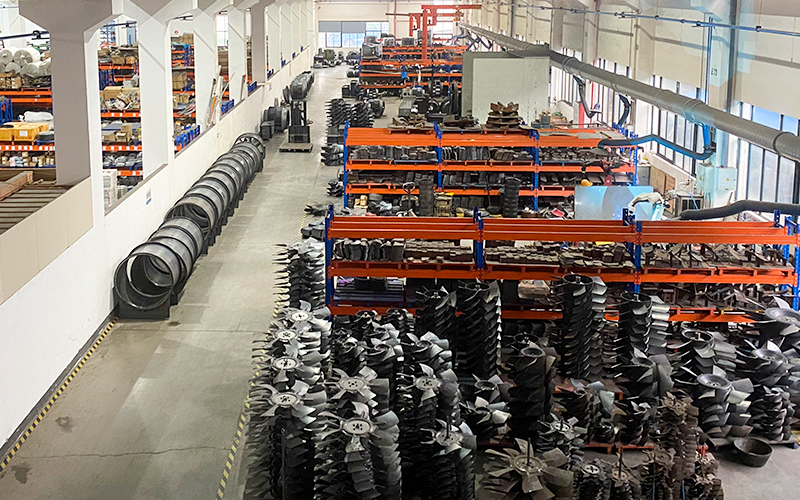
Impeller selection heavily dictates overall performance. Manufacturers utilize several distinct blade designs. Each shape offers specific advantages. You must align the blade profile carefully to your exact application.
Not all industrial applications function under standard conditions. Certain processes demand extreme aerodynamic force. You must know exactly when to upgrade your equipment specification.
We must first define "high pressure" clearly. Engineers typically measure static pressure in inches of water gauge (in. w.g.). Standard HVAC systems operate around 2 to 4 in. w.g. A true High Pressure Centrifugal Fan usually operates well above 15 in. w.g. Some specialized units push past 100 in. w.g. These models fall into the high-velocity category.
Several target use cases demand this extreme force. Pneumatic conveying systems rely on them entirely. Granular materials need massive pressure to travel through pipes. Combustion air supply systems require them. Burners need highly pressurized air to maintain optimal flame geometry. Deep-bed chemical filtration creates immense friction. Scrubbers packed heavily require high-pressure units. Localized industrial cooling also depends heavily on high-velocity air streams.
Manufacturers employ specific design modifications here. These units differ structurally from standard models. They feature much narrower casing widths. They utilize larger wheel diameters to generate higher tip speeds. They use extremely heavy gauge steel. Thick materials prevent devastating material fatigue under intense stress. The bearings and shafts are oversized robustly.
You must acknowledge serious implementation risks. Do not over-size these specific machines. Over-sizing leads directly to aerodynamic instability. We call this phenomenon "surge". Surge happens if the equipment operates too far left on its performance curve. The unit gasps for air. It fails to push the air forward steadily. This causes violent, localized reverse flow. Severe vibration follows immediately. Surge can literally tear heavy ductwork apart.
Procuring industrial air movement equipment requires rigorous technical evaluation. You cannot rely on guesswork. Systematic evaluation prevents catastrophic field failures.
Maximizing airflow and static pressure relies entirely on precise engineering matches. You must pair the specific impeller type and fan class directly to your exact system resistance. Ignoring this principle leads to severe performance degradation. Every duct layout, filter bank, and industrial process creates a unique aerodynamic footprint.
Engineers and procurement teams must complete their homework early. Gather your precise CFM requirements thoroughly. Calculate your worst-case static pressure accurately. Do this before you ever consult a manufacturer. Having solid data prevents costly misapplications.
Take action on your next ventilation project today. Use an online sizing calculator to test your parameters. Download a comprehensive technical specification guide from a reputable manufacturer. Contact a qualified application engineer immediately for a custom performance review.
A: No. According to the fan laws, static pressure varies directly with the square of the fan speed (RPM). If you double the rotational speed, you quadruple the static pressure. Speed adjustments drastically alter pressure capabilities.
A: This is usually caused by operating at a lower system resistance than originally designed. This happens frequently with forward-curved blades. Less resistance means the machine moves significantly more air volume. Moving more air quickly overloads the motor.
A: It is not recommended. Forward or backward-curved blades will accumulate heavy debris rapidly. This causes severe mechanical unbalance. Radial blade configurations are absolutely required for harsh material handling and dust collection.
A: Operating too close to the "shut-off" point on the curve causes aerodynamic stall. Here, system resistance is simply too high for the impeller to push air forward. This restriction causes localized reverse flow, dropping efficiency and creating severe vibration.


