


close
Choose Your Site
Global
Social Media

Views: 0 Author: Site Editor Publish Time: 2026-06-22 Origin: Site


Industrial facilities rely on powerful ventilation to stay safe and operational. Good airflow prevents dangerous fume buildup. It also cools heavy machinery and ensures strict regulatory compliance. However, many engineers make a critical mistake during early system design. They specify the wrong fan type for their specific application.
Placing an axial fan into a high-pressure duct system causes immediate problems. The system suffers from choked airflow, wasted energy, and early motor failure. Complex layouts require robust equipment built for intense air resistance. You will quickly see why Centrifugal Fans dominate these challenging environments. They generate massive static pressure, survive harsh chemical airstreams, and keep air moving smoothly.
We will explore how impeller shapes, material choices, and installation planning determine your ventilation success. You will learn to match fan performance curves to your specific facility needs.
How do these machines actually move air? The mechanics rely on a simple 90-degree airflow deflection. Air enters the center of the rotating impeller. The spinning blades catch this incoming air immediately. Centrifugal force then throws the air outward radially. This violent redirection slows the air velocity down. However, it drastically increases the static pressure of the airstream. This physical conversion separates them entirely from standard axial models.
You must establish a clear decision boundary when designing a system. Axial models serve high-volume, low-pressure applications. You use them to move free air across an open room. Conversely, you require an Industrial Centrifugal Fan the moment you introduce system resistance. Resistance comes from long ductwork runs, dense filter banks, or chemical scrubbers. Axial models fail quickly when they encounter this backpressure.
Reliability in variable conditions provides another major engineering advantage. Industrial environments rarely maintain perfect consistency. Filters slowly clog with dust over time. Dampers open and close based on process demands. Centrifugal designs maintain a remarkably stable operating point on their performance curve. They continue delivering reliable airflow even as system resistance fluctuates. This stability prevents process shutdowns and protects your motors from sudden overheating.
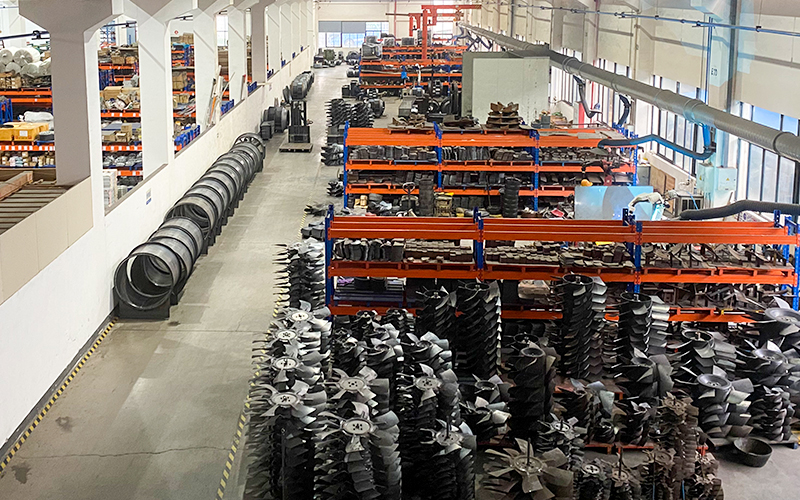
Your airstream characteristics dictate your impeller choice. You cannot use a single blade design for every industrial process. You must match the blade profile to the exact type of air you intend to move.
Radial blades project straight out from the central hub. They look like a traditional paddle wheel. You should choose this design for extreme material handling. They dominate in sawmills, cement plants, and metal fabrication shops.
Best for: Heavy dust, wood chips, high temperatures, and abrasive materials.
Trade-offs: They offer the lowest energy efficiency of all designs. However, they provide the highest durability. The straight blades possess incredible self-cleaning capabilities. Dust cannot easily cling to the flat surfaces during high-speed rotation.
These blades tilt away from the direction of rotation. This aerodynamic shape slices through the air smoothly. Engineers frequently specify them for large forced-draft systems and building exhaust networks.
Best for: Clean to lightly contaminated air and high-efficiency requirements.
Trade-offs: They feature a non-overloading horsepower curve. The motor will not burn out even if system resistance drops unexpectedly. Unfortunately, you cannot use them to handle heavy particulates. Sticky dust easily builds up on the back of the curved blades. This buildup ruins the fan balance and causes severe vibration.
These impellers feature dozens of small, curved blades. They tilt forward in the direction of rotation. They resemble a small hamster wheel.
Best for: Low-pressure commercial and light-industrial ventilation. They shine where physical space remains highly constrained.
Trade-offs: They move large amounts of air at low speeds, making them very quiet. However, they strictly require clean air applications. They also remain highly prone to overloading. If you remove duct resistance, the motor will draw excess current and fail.
| Impeller Type | Ideal Airstream | Key Advantage | Major Limitation |
|---|---|---|---|
| Radial | Heavy dust, abrasives | Self-cleaning, highly durable | Low energy efficiency |
| Backward-Inclined | Clean, light dust | High efficiency, non-overloading | Prone to imbalance from dust buildup |
| Forward-Curved | Very clean air | Compact size, quiet operation | Motor overloading risk |
Procuring heavy ventilation equipment requires meticulous engineering analysis. You must evaluate specific operational dimensions before issuing a purchase order. Skipping these steps often leads to catastrophic field failures.
You must carefully match the fan's performance curve to your facility's system resistance curve. Every duct, elbow, and filter creates friction. You calculate this total friction as static pressure. Plot this pressure against your required airflow volume. The intersection forms your operating point.
Common Mistake: Engineers frequently over-specify motor size just to be safe. Oversizing pushes the fan off its peak efficiency point. This forces the unit to operate poorly, generates excess noise, and wastes substantial electrical power.
Standard carbon steel works perfectly for dry, clean indoor applications. However, industrial environments often involve harsh chemicals or extreme moisture. You must evaluate housing and blade materials based on these exact exposures.
Explosive dust and flammable gases present massive safety risks. A simple spark from a metal fan blade can ignite the entire facility. You must assess the need for spark-resistant construction. Industry bodies like AMCA provide strict classifications for these environments.
AMCA defines three primary categories for spark resistance. Type A requires all airstream components to use non-sparking materials. Type B requires only the impeller to be non-sparking. Type C simply features a non-sparking buffer ring around the shaft opening. You must also ensure full ATEX compliance if your facility operates within regulated explosive zones.
Even perfectly specified equipment will fail if you install it poorly. Field conditions rarely match pristine laboratory testing environments. You must plan for physical installation challenges.
Manufacturer catalogs display performance curves generated under ideal conditions. Real-world duct design often ruins this performance. We call this the "system effect." Poor duct layouts at the fan inlet or outlet drastically reduce actual airflow. Placing a sharp duct elbow directly against the fan inlet creates massive turbulence.
Best Practice: Leave at least three fan diameters of straight ducting at the discharge outlet. This allows turbulent air to stabilize and recover its static pressure.
You must acknowledge the physical realities of installing heavy industrial equipment. These units require a substantial footprint. They also demand heavy-duty mounting frameworks. You cannot place a massive blower on a weak structural floor. The sheer torque generated during motor startup requires rigid structural support. Always verify floor load capacities before delivery.
Heavy rotational equipment generates substantial mechanical vibration and acoustic noise. You cannot let this energy transfer into your building structure. Managing this requires a multi-layered approach.
Lifecycle management requires regular access to internal components. You must factor maintenance features into your initial design. Request bolted clean-out doors on the fan housing. This allows technicians to wash down the impeller safely. Specify split housings for extremely large units. A split housing allows you to remove the giant motor and impeller without dismantling the entire duct system. Finally, always include bottom drain connections to remove accumulated moisture safely.
Selecting the right vendor proves just as critical as selecting the right impeller. The industrial market offers everything from basic catalog fans to fully custom-engineered beasts.
You must decide when to rely on standardized models. Standard catalog fans work perfectly for basic warehousing ventilation. They ship quickly and cost less. However, complex processes require custom engineering. You should commission custom builds for high-heat exhaust, abrasive material handling, or highly corrosive chemical environments. Custom vendors can alter blade thickness, upgrade shaft seals, and apply specialized protective coatings.
Never trust unverified marketing claims regarding airflow. You must choose manufacturers that provide certified ratings. Look for vendors who test their equipment according to AMCA 210 standards. This certification guarantees that the fan actually delivers the promised air performance and sound levels. Buying uncertified equipment introduces massive risk into your facility design.
Industrial fans run continuously for years. They will eventually require service. You must evaluate your vendor's ability to provide rapid support. Check their inventory of replacement parts. Ask if they offer field balancing services. Impellers naturally lose their balance over time due to wear. A strong partner will dispatch technicians to perform laser alignment and dynamic field balancing to keep your lines running.
Specifying industrial ventilation equipment requires careful attention to detail. The final decision always hinges on your facility's specific pressure requirements. You must also rigorously assess the exact nature of your airstream. Clean air allows for highly efficient backward-inclined designs. Particulate-laden air demands durable, self-cleaning radial impellers. Taking shortcuts during this evaluation phase guarantees system failure and costly downtime.
To move forward successfully, gather your environmental data first. Document your operating temperatures, chemical exposures, and available footprint. Next, consult directly with an applications engineer. Ask them to accurately plot your system resistance curve. Only after confirming this intersection point should you issue a formal request for quotation to a certified manufacturing partner.
A: The main difference lies in pressure generation and the airflow path. Axial fans pull air straight through, moving large volumes at very low pressure. Centrifugal models pull air into the center and throw it outward at a 90-degree angle. This creates high static pressure, allowing them to push air through heavy resistance like long ducts and filters.
A: Yes, they can handle explosive environments safely if built properly. You must specify spark-resistant construction. Manufacturers use non-ferrous materials like aluminum or special buffer rings to prevent sparks. Always ensure the unit carries the appropriate AMCA spark-resistant rating (Type A, B, or C) and meets strict ATEX compliance standards.
A: A well-maintained unit can easily last 15 to 20 years. Lifespan heavily depends on your operating environment and maintenance routine. Handling abrasive dust or corrosive fumes shortens life expectancy. Regular dynamic balancing, bearing lubrication, and proper material selection (like using FRP for acids) significantly extend the equipment's operational life.
A: This usually stems from the "system effect." Poor duct design near the equipment creates massive turbulence. Installing sharp elbows, closed dampers, or irregular transitions immediately at the inlet or outlet restricts airflow. The fan struggles to overcome this unexpected resistance, causing it to fall short of its laboratory-rated performance curve.


