


close
Choose Your Site
Global
Social Media

Views: 0 Author: Site Editor Publish Time: 2026-06-28 Origin: Site


Industrial operations face massive daily challenges. Facilities must move huge volumes of air to maintain safety. Managers must manage ambient heat and ensure strict regulatory compliance. However, floor space and energy budgets remain strictly capped. How do you solve this airflow problem efficiently? Axial Fans provide the ideal engineering solution. Manufacturers design these units specifically for high-volume, low-pressure air movement. They pull air parallel to the rotating central shaft. This aerodynamic approach maximizes air transfer. It keeps operational demands remarkably low. This article moves beyond basic equipment definitions. We will evaluate exactly when, why, and how to specify an Industrial Ventilation Fan for your facility. You will learn critical system limitations. You will also discover key specification parameters to guarantee optimal performance. Let us explore how to match the right equipment to your specific constraints.
Axial fans deliver the highest Cubic Feet per Minute (CFM) to energy consumption ratio in low-static-pressure environments.
Compact, inline design allows for seamless integration into existing ductwork, minimizing facility footprint requirements.
Choosing between axial and centrifugal systems hinges strictly on the particulate load and static pressure resistance of the specific application.
Proper specification requires balancing blade pitch, motor drive type (direct vs. belt), and acoustic compliance (OSHA standards).
Managers continually struggle balancing airflow requirements against rising energy demands. Axial units dominate high-volume applications safely. They operate on a brilliantly simple aerodynamic principle. The impeller draws incoming air parallel to the motor shaft. This mechanism maximizes sheer air volume delivery. It prioritizes volume over generating high internal pressure. Facility layout presents another massive hurdle. Industrial space remains extremely expensive. It is highly limited. Bulky equipment wastes valuable operational floor space. The straight-through flow design solves this layout issue perfectly. You can mount these units directly inside existing ductwork. You can also install them straight into exterior facility walls. This strategy frees up crucial ground areas.
Energy efficiency forms a major operational advantage. Operating in a low-resistance environment reduces power demands significantly. These specific models require much lower horsepower to move equivalent air volumes. You save electricity during every single operating hour. High-volume air transfer happens seamlessly. Managers see immediate reductions in utility consumption. They achieve better overall facility airflow.
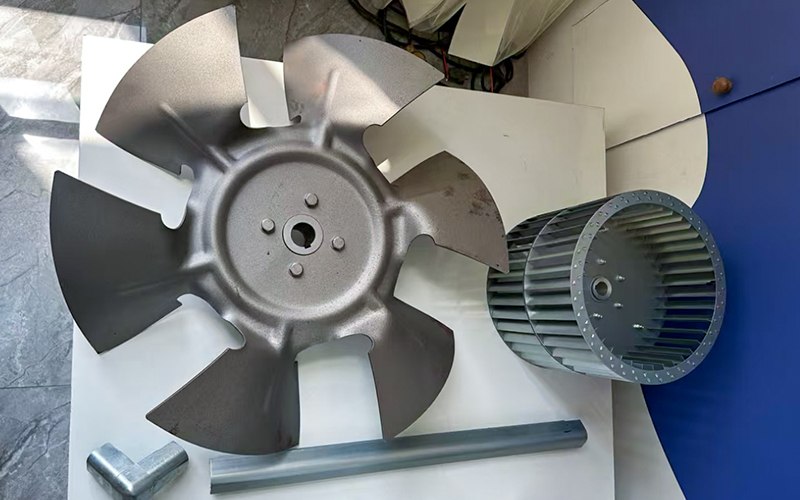
Choosing between different equipment types dictates your ultimate system success. You must weigh your desired Cubic Feet per Minute (CFM) against system static pressure. We have provided a technical comparison chart below.
| Specification Feature | Axial System | Centrifugal System |
|---|---|---|
| Airflow Volume (CFM) | Exceptionally High | Moderate to High |
| Static Pressure Capability | Low to Moderate | Very High |
| Airflow Trajectory | Inline (Straight-through) | 90-Degree Turn |
| Space Requirement | Minimal / Duct-mounted | Large / Floor-mounted |
Axial Fans excel in free-air delivery scenarios. They easily dominate short, straight duct runs. Such setups offer very minimal air resistance. Conversely, centrifugal systems become absolutely mandatory elsewhere. Complex ductwork demands raw centrifugal power. Filtration setups require them. High-static-pressure needs rely on centrifugal force.
Airflow trajectory impacts facility retrofitting heavily. Inline flow allows simple integration. Centrifugal units force a 90-degree directional change. This turn complicates ductwork design. It increases installation complexity.
Particulate handling presents a critical limitation. Standard inline units fail rapidly in harsh environments. Heavy, sticky dust clogs standard blades. Highly abrasive airborne particulates erode impellers quickly. Specialized centrifugal blowers handle these harsh contaminants much better. You must analyze your specific facility air quality before purchasing.
Properly specifying an Industrial Ventilation Fan requires strict evaluation of the impeller design. You must evaluate fixed-pitch versus adjustable-pitch blades. Fixed blades offer simple, reliable performance. They work well for unchanging operational environments. Adjustable blades offer dynamic flexibility. They allow facilities to future-proof their ventilation setups entirely. You can tweak airflow capacity easily. You simply alter the blade angle. This prevents replacing the entire unit if facility needs expand later. It provides remarkable adaptability.
Motor placement drastically affects performance and maintenance routines. Each drive type presents unique advantages.
Direct Drive: The motor connects directly to the impeller wheel. This creates a highly compact footprint. Efficiency remains incredibly high. Energy loss is virtually zero. However, it exposes the motor directly to the airstream. This becomes dangerous if the exhausted air is hot, corrosive, or hazardous.
Belt Drive: This configuration keeps the critical motor safely outside the main airstream. It is ideal for exhausting high-temperature fumes. It works perfectly for contaminated exhaust paths. However, it demands strict preventative maintenance. Technicians must regularly inspect belts and lubricate external bearings.
Engineers must assess material choices based on environmental corrosiveness. Basic cast aluminum works well for standard ambient exhaust. Spark-resistant alloys become legally required in volatile areas. Fiberglass-reinforced plastic (FRP) provides incredible chemical resistance. It dominates highly corrosive industrial environments. Explosion-proof ATEX certifications govern hazardous locations. You must match the construction material precisely to your atmospheric hazards.
Understanding ideal use cases prevents catastrophic system failures. We see inline air movers succeed brilliantly in specific environments.
Ideal Use Cases:
Warehouse Cooling: Moving massive volumes of ambient air across vast open storage spaces.
Paint Spray Booths: Exhausting hazardous fumes quickly. Engineers use tube-axial or vane-axial designs equipped with isolated motors here.
Cooling Towers: Extracting waste heat rapidly from internal heat exchangers.
Where to Avoid Them (Transparent Limitations):
These units fail under specific heavy-resistance conditions. Never install them inside long, winding duct systems. Multiple elbows create massive static pressure drops. The equipment will stall. Systems requiring dense HEPA filtration block airflow completely. High-resistance scrubbers choke the impeller. Finally, avoid material handling applications. Solid debris passing through the housing will destroy the rapidly spinning blades instantly.
High-speed rotating equipment introduces distinct workplace risks. Acoustic profiling remains a primary safety concern. High-speed units generate significant decibel levels. Noise ordinance compliance is non-negotiable. Industrial facilities must meet strict OSHA acoustic standards. You will likely need acoustic silencers. Sound-attenuating enclosures block radiating noise effectively. Variable frequency drives (VFDs) lower rotational speeds during off-peak hours. This dramatically reduces unnecessary sound generation.
Stall and surge present severe aerodynamic risks. Operating outside the intended performance curve is incredibly dangerous. It causes aerodynamic stall immediately. Air detaches from the blade surfaces. Severe structural vibration occurs rapidly. Catastrophic mechanical failure follows shortly after. Engineers must ensure the system resistance matches the published fan curve precisely.
Mounting introduces distinct structural challenges. Heavy industrial units require robust suspension systems. You cannot simply bolt them to standard rafters. You must install proper vibration isolators. Spring isolators prevent kinetic energy transfer. Neoprene pads dampen structural resonance. These precautions protect your entire facility infrastructure from fatigue.
Successful procurement relies on highly accurate engineering data. Guesswork leads to guaranteed system underperformance. You must compile precise technical requirements beforehand.
First, list the non-negotiable metric data. Your vendor needs your exact Target CFM. They need your total system static pressure measured in inches of water gauge. They require the maximum operating temperature range. Altitude also matters immensely. Air density changes at higher elevations. This directly impacts overall performance capacity. Standard charts assume sea-level air density. You must adjust for higher altitudes appropriately.
Second, define your control requirements. Decide if you need a static single speed. Determine if a variable frequency drive (VFD) suits your changing process demands better.
Your next steps require professional technical validation. We strongly advise consulting an application engineer. Ask them to run a computational fluid dynamics (CFD) model. Request a detailed system curve analysis. Compare this curve against the manufacturer data. Finalize your procurement only after verifying these overlapping technical models.
An industrial ventilation setup is never a basic, one-size-fits-all commodity. It requires precise engineering alignment. Incorrect specifications result in poor safety and wasted energy.
Prioritize axial solutions for high-volume, straight-line airflow layouts.
Verify your particulate loads and ensure static pressure remains low.
Match motor configurations strictly to your exhaust air hazards.
Consult engineering experts to run a proper system curve analysis.
These inline solutions remain optimal for moving immense air volumes efficiently. They save incredible amounts of operational space. Please contact a dedicated engineering team today. Request a custom performance curve analysis. They will match the perfect aerodynamic profile to your exact facility constraints.
A: Yes. You can use tube-axial and vane-axial types. However, the duct run must remain relatively short and completely straight. The overall static pressure must remain low to prevent aerodynamic stall.
A: They absolutely can be. Manufacturers offer specialized spark-resistant construction. You can pair these with explosion-proof motors. This creates a fully compliant unit safe for hazardous, combustible environments.
A: Vane-axial models feature internal stationary guide vanes. These vanes recover wasted rotational energy from the spinning airstream. This significantly increases static pressure capabilities and boosts overall aerodynamic efficiency.
A: Lifespan depends entirely on the duty cycle. It relies heavily on strict maintenance adherence. Clean, ambient environments allow decades of use. Harsh, corrosive operating environments reduce longevity considerably without specialized protective materials.


