


close
Choose Your Site
Global
Social Media

Views: 0 Author: Site Editor Publish Time: 2026-06-29 Origin: Site


Standard specification sheets often look perfect on paper. You review the laboratory metrics, and the airflow volumes seem more than sufficient for your application. However, achieving those numbers in real-world industrial and commercial environments presents a completely different challenge. Laboratory conditions rarely mirror the complex realities of an active facility.
Achieving optimal airflow and long-term reliability requires deeper analysis. You must understand how internal aerodynamic design interacts directly against external environmental variables. Real-world system resistance constantly fights against your equipment. Relying purely on baseline metrics often leads to severe underperformance, unpredictable energy spikes, and premature equipment failure. You need a more robust approach to equipment specification.
This guide breaks down the essential variables influencing efficiency. You will discover common implementation bottlenecks to avoid during installation. We also detail the technical criteria needed to specify the correct unit for your unique setup. By understanding these dynamics, you can ensure your ventilation systems perform exactly as intended.
Blade geometry and pitch dictate the baseline performance curve, but system static pressure determines actual operational efficiency.
Environmental factors like air density, temperature, and altitude significantly alter volume and power requirements.
Installation geometry, particularly limited air intake or improper shrouding, is the leading cause of premature failure and aerodynamic stall.
Selecting between an axial flow fan and a centrifugal fan depends entirely on the required flow-to-pressure ratio and spatial constraints.
Internal engineering strictly dictates baseline capabilities. Manufacturers carefully design every physical component to optimize air movement. Understanding these design choices helps you match the equipment to your operational demands.
The angle of attack directly influences airflow volume versus power consumption. Engineers set the blade pitch to determine how aggressively the fan bites into the air. Steeper pitches move significantly more air per revolution. They deliver higher Cubic Feet per Minute (CFM) ratings.
However, steep pitches demand much higher torque from the motor. If system resistance increases unexpectedly, steep-bladed fans risk aerodynamic stall. The air detaches from the blade surface, causing a massive drop in efficiency. Shallow pitches offer lower CFM but handle slight pressure increases more gracefully. You must balance the desired volume against the potential for fluctuating system resistance.
Blade shape changes how air moves through the housing. The number of blades and their specific profile impact both aerodynamic efficiency and noise generation. Different profiles serve distinct operational needs.
Airfoil Blades: These mimic airplane wings. They provide highly efficient, uniform airflow. They work best in clean environments requiring consistent volume.
Sickle Blades: These feature a swept-back design. They slice through the air gradually. This profile significantly reduces turbulence and acoustic noise. They excel in commercial HVAC systems where quiet operation matters.
Paddle Blades: These feature flat, simple geometries. They offer lower efficiency but handle rugged environments better. You often see them in heavy-duty industrial settings.
Adding more blades generally increases pressure capability but restricts total free air delivery. Fewer blades maximize sheer volume at zero static pressure.
Motor capacity directly limits performance stability. The relationship between motor type and consistent RPM determines reliability under fluctuating loads. Traditional AC motors provide simple, robust power. However, they often experience RPM slip when system resistance changes.
Conversely, DC brushless motors maintain much tighter speed control. They adjust torque dynamically to keep RPM steady. When specifying Axial Fans, matching the motor's horsepower curve to the highest expected resistance point prevents overloading. An undersized motor will overheat attempting to maintain speed against unexpected backpressure.
The gap between the blade tip and the housing defines the tip clearance. This tiny measurement is critical for preventing air recirculation. If the gap is too wide, high-pressure air from the exhaust side bleeds back to the intake side. This recirculation destroys aerodynamic efficiency and drops overall pressure.
Tight tolerances keep the air moving in one linear direction. High-quality shrouds feature spun or perfectly cylindrical designs. They guide air smoothly across the blades. Over time, vibrations can shift the motor mount. This movement risks blade-to-housing contact if tolerances are extremely tight. Regular maintenance ensures the shroud remains perfectly concentric.
External conditions completely alter theoretical performance numbers. Catalog specifications assume standard air at sea level. Your facility likely operates under very different realities.
Air density changes dramatically based on elevation. Fans operate as constant-volume machines. They will always move the same physical volume of air at a specific RPM. However, they move significantly less mass of air at high altitudes.
Because the air is thinner, a fan operating in Denver moves less oxygen and cooling mass than one in Miami. If your process relies on mass transfer—like cooling a generator or feeding combustion—you must increase the fan's RPM or select a larger diameter unit. Failing to adjust for altitude leads to severe overheating issues, despite the CFM looking correct on paper.
Heat degrades mechanical components rapidly. Elevated temperatures expand metal parts, potentially closing tight tip clearances and causing friction. High ambient heat also challenges the motor.
Motor winding insulation deteriorates much faster in hot environments. Bearing lubrication thins out, losing its protective viscosity. This leads to metal-on-metal wear. If you operate in extreme heat, you must specify Class F or Class H motor insulation. You should also ensure the bearings use high-temperature synthetic grease. Cold extremes present opposite challenges. Standard grease can freeze, preventing the motor from turning over upon startup.
Airborne contaminants destroy blade balance. Dust, moisture, and chemical vapors attach to the blade surfaces over time. This uneven buildup throws the rotating assembly out of balance. The resulting vibration destroys bearings rapidly.
Moisture: Causes rapid oxidation on standard steel components.
Chemical Vapors: Eat away at aluminum and standard paints, weakening structural integrity.
Heavy Dust: Requires frequent cleaning protocols to prevent catastrophic vibration spikes.
To combat these issues, specify appropriate material selections. Fiberglass-reinforced plastics (FRP) resist chemical attack perfectly. Epoxy coatings protect steel housings from moisture. Choosing the right material ensures the aerodynamic profile remains intact over years of continuous operation.
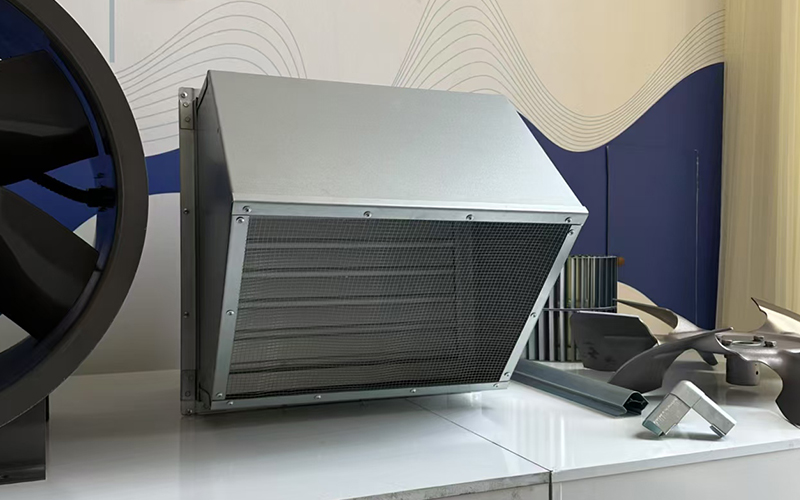
Real-world rollout lessons consistently point to installation errors as the root cause of underperformance. Even the best-engineered unit will fail if installed improperly.
Insufficient clearance at the inlet chokes the equipment. This "starving" effect causes uneven velocity profiles across the blade span. When you place a wall or heavy machinery too close to the intake, air rushes in unevenly.
This turbulence severely impacts efficiency. The blades grab varying amounts of air, causing vibration and a massive drop in CFM. As a general rule, you must provide at least one full fan diameter of unobstructed clearance at the intake. Compact industrial setups frequently violate this rule, leading to noisy, underperforming ventilation systems.
Understanding operational limits saves you from catastrophic failures. Axial designs excel at moving high volumes of air, but they struggle against high duct resistance. Forcing this equipment against high static pressure pushes it out of its stable operating zone.
When resistance exceeds the design limit, the system experiences aerodynamic stall. The air simply spins around the blades rather than moving forward. You will hear a distinct surging or pulsing noise. This surging causes extreme mechanical stress, frequently snapping blades or burning out motors.
Abrupt changes in duct geometry destroy linear airflow. Placing sharp 90-degree elbows, heavy dampers, or thick safety guards directly adjacent to the fan disrupts performance. The air needs space to stabilize before and after passing through the blades.
Transitions should feature gradual slopes. If you must use a guard, ensure the wire spacing does not restrict more than 10% of the open area. Proper installation geometry respects the physics of air movement.
| Installation Mistake | Aerodynamic Consequence | Mechanical Result |
|---|---|---|
| Blocked or tight intake clearance | Uneven air velocity profile, starvation | Vibration, reduced CFM, higher noise |
| Sharp duct elbows directly at discharge | Massive spike in static pressure | Aerodynamic stall, motor overheating |
| Oversized wire safety guards | Airflow restriction and surface drag | 10-15% drop in total efficiency |
| Loose mounting hardware | Housing distortion | Blade tip rubbing, catastrophic failure |
Ensuring you choose the correct fundamental technology dictates project success. You must evaluate the business problem before committing to a specific design. The choice often comes down to the required flow-to-pressure ratio.
You should specify an Axial Flow Fan when you need high volume and low static pressure. They excel in general warehouse ventilation, agricultural exhaust, and cooling towers. Their straight-through linear flow fits perfectly into tight spatial constraints.
They mount easily into walls or roof panels. If you need to move a massive amount of air quickly without pushing it through long, complicated ductwork, this technology provides the most efficient and compact solution.
Certain applications demand different physics. You must pivot to centrifugal options when facing high static pressure. Ducted systems featuring multiple bends, HEPA filters, or heavy particulate handling require the brute force of a centrifugal impeller.
Centrifugal units throw air outward radially, generating significantly higher pressure capabilities. They handle dirty airstreams better because the motor often sits outside the primary airflow path. If your system resistance exceeds 2 to 3 inches of water gauge, centrifugal technology becomes the safer, more reliable choice.
Initial capital expenditure always matters during procurement. Axial designs generally cost less upfront. They require less raw material and feature simpler manufacturing processes. They also consume less physical space, reducing installation costs.
However, long-term energy consumption depends heavily on the specific duty point. Operating a unit outside its optimal curve wastes massive amounts of electricity. You must compare the expected energy draw over a five-year period. Sometimes paying a premium for a highly efficient centrifugal unit pays off if you face constant, high-pressure demands.
| Feature | Axial Flow Technology | Centrifugal Technology |
|---|---|---|
| Airflow Direction | Straight through (Linear) | 90-degree change (Radial) |
| Volume (CFM) | Extremely High | Moderate to High |
| Static Pressure Capability | Low to Moderate | Very High |
| Space Requirement | Compact / In-line | Bulky / Requires separate housing |
| Best Application | Wall exhaust, cooling towers | Complex ductwork, heavy filtration |
Shortlisting the right equipment requires a structured logic. You cannot rely on guesswork. Using compliance-aware evaluation criteria ensures you purchase a reliable, efficient unit.
You must map your required CFM and static pressure directly onto the manufacturer's performance curve. Every fan has a specific curve illustrating how it performs under different resistance levels. Do not just look at the maximum CFM rating.
Identify the Best Efficiency Point (BEP). This point represents where the unit delivers maximum airflow for the least amount of electrical input. You want your normal operating conditions to sit squarely on the BEP. Operating too far to the left or right of this point guarantees energy waste and mechanical strain.
Evaluating your power supply dictates control capabilities. Traditional AC motors work fine for simple on/off applications. However, modern facilities increasingly demand variable speed control to match changing ventilation needs throughout the day.
Specifying Electronically Commutated (EC) motors transforms system efficiency. EC motors combine AC power input with internal DC control. They allow seamless integration with Building Management Systems (BMS). They maintain high efficiency even when running at 50% speed. If you need precise control and energy compliance, EC motors offer the best technological path forward.
Never trust unverified catalog claims. Ensure the equipment carries proper certifications. The Air Movement and Control Association (AMCA) sets strict testing standards for aerodynamic and acoustic performance.
Verifying AMCA certification guarantees the unit will perform exactly as advertised under standard conditions. It protects you from inflated marketing numbers. Specifying AMCA-certified equipment is a mandatory best practice for commercial and industrial projects, ensuring regulatory compliance and peace of mind.
Axial fan performance relies on a dynamic, interconnected equation. You must balance internal blade design against harsh environmental realities and physical installation geometry. Overlooking any single variable guarantees reduced efficiency.
Relying solely on catalog CFM ratings presents a massive risk. If you fail to calculate true system resistance or ignore intake constraints, you will install an inefficient system prone to premature wear. Mitigate this risk through careful, site-specific planning.
Start your next steps by auditing your specific spatial constraints. Calculate your true static pressure requirements accurately. Finally, consult with an engineering partner to match the performance curve perfectly to your exact duty point. Precision in specification prevents catastrophic failures in operation.
A: Airflow loss usually stems from an increase in system resistance. Clogged filters, closed dampers, or dirt buildup on the blades force the fan to push against higher static pressure. If the pressure exceeds design limits, the unit experiences aerodynamic stall, causing a sharp drop in volumetric efficiency despite the motor running at full speed.
A: Limited intake space "starves" the equipment. It prevents air from entering the blades uniformly. This uneven entry causes severe turbulence and vortex shedding. Consequently, the fan generates increased acoustic noise, vibrates heavily, and suffers a dramatic reduction in its ability to move air efficiently.
A: Yes, temperature alters air density. Hotter air is significantly less dense. Because a fan moves a constant volume, moving less dense air means it moves less physical mass. This directly impacts cooling effectiveness. Extreme heat also degrades bearing lubrication and motor insulation faster.
A: AC fans connect directly to standard grid power, offering simple, robust operation but limited speed control. DC fans, particularly EC (Electronically Commutated) variants, provide precise variable speed control. They consume significantly less power, integrate easily into automated systems, and maintain stable RPM even when voltage fluctuates.


