


close
Choose Your Site
Global
Social Media

Views: 0 Author: Site Editor Publish Time: 2026-02-02 Origin: Site


When selecting fans for industrial, commercial, or residential applications, one of the most important decisions to make is choosing between axial fans and centrifugal fans. Both types of fans are designed to move air, but they work in different ways and are suited for different purposes. Understanding the key differences between these two types of fans is essential for selecting the right equipment for your specific needs. This article will explore the differences between axial fans and centrifugal fans, highlighting their features, working principles, advantages, disadvantages, applications, and much more.
Although both types of fans are used to move air, they operate differently and are suited to different applications. Below is a detailed comparison of axial fans and centrifugal fans, focusing on various parameters:
The most significant difference between axial fans and centrifugal fans lies in the direction of the airflow. Axial fans move air along the axis of rotation, while centrifugal fans move air at a right angle to the intake. This difference in airflow direction significantly impacts the performance and application of each fan type.
| Fan Type | Airflow Direction |
|---|---|
| Axial Fans | Parallel to the axis |
| Centrifugal Fans | At a right angle to the intake |
Axial fans are designed to generate low pressure, making them ideal for ventilation applications or systems that require moving large volumes of air over short distances. Centrifugal fans, on the other hand, produce high pressure, which is required for systems with higher resistance, such as air filtration, ductwork, and blowers.
| Fan Type | Pressure Generation |
|---|---|
| Axial Fans | Low pressure |
| Centrifugal Fans | High pressure |
The efficiency of a fan depends on the type of application and the pressure requirements. Axial fans are generally more efficient in moving large volumes of air, especially in systems that require low-pressure airflow. On the other hand, centrifugal fans may consume more energy to generate higher pressures, which makes them less energy-efficient compared to axial fans in low-pressure applications.
| Fan Type | Efficiency |
|---|---|
| Axial Fans | High efficiency, low power |
| Centrifugal Fans | Lower efficiency, higher power |
Axial fans are typically larger and longer, with simple blades that provide a high volume of airflow. These fans are cost-effective and easy to manufacture. Centrifugal fans, on the other hand, have a more compact and complex design. Their ability to generate higher pressure often requires a more intricate construction, making them bulkier and more expensive.
| Fan Type | Design |
|---|---|
| Axial Fans | Larger, simpler design |
| Centrifugal Fans | More compact, complex |
One important factor to consider when choosing a fan is the noise level. Axial fans tend to produce more noise due to the high volume of air they move. Centrifugal fans, however, generally operate more quietly because their design allows them to move air more efficiently through ducts and systems with higher resistance.
| Fan Type | Noise Levels |
|---|---|
| Axial Fans | Higher noise |
| Centrifugal Fans | Lower noise |
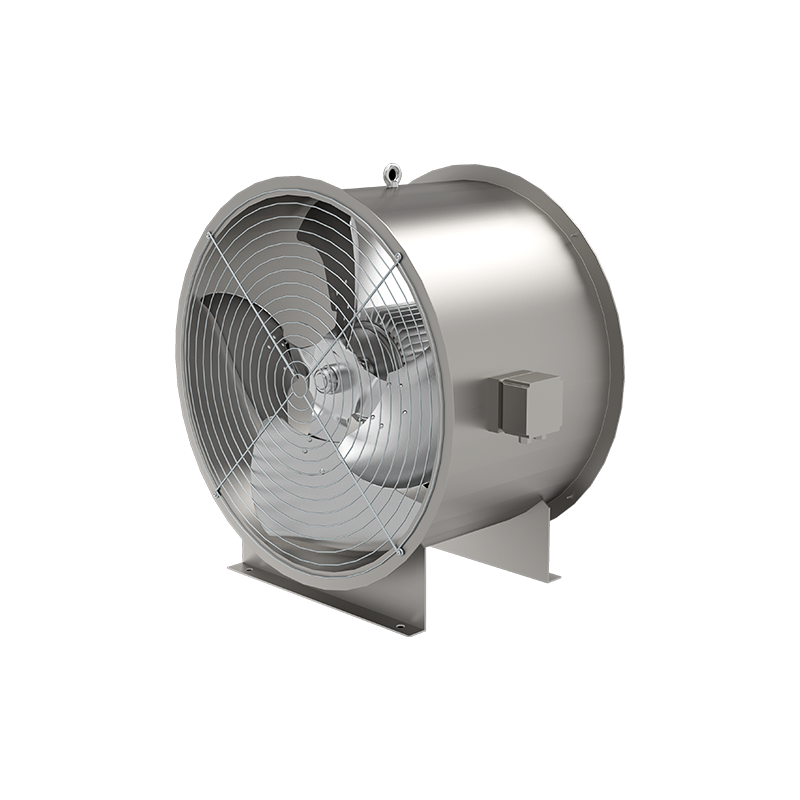
Axial fans are commonly used in applications that require high airflow but low pressure. Some examples of where axial fans are used include:
Cooling Towers: Axial fans are used in cooling systems to dissipate heat in large-scale industrial processes.
Ventilation Systems: In large commercial or industrial buildings, axial fans are used for ventilation purposes, helping to circulate fresh air and remove stale air.
Exhaust Fans: Axial fans are also used in exhaust systems for industrial applications where large volumes of air need to be removed.
Industrial Equipment Cooling: In computers and electronic devices, axial fans are used to cool down equipment and maintain optimal operating temperatures.
High airflow capacity
Energy-efficient
Low cost
Simple design
Low pressure
Higher noise production
Centrifugal fans are better suited for applications that require high-pressure airflow. These fans are typically used in the following applications:
HVAC Systems: Centrifugal fans are widely used in heating, ventilation, and air conditioning systems, especially where air needs to be moved through ducts or systems with resistance.
Industrial Exhaust: Centrifugal fans are used in exhaust systems, such as fume extraction and dust collection systems, where higher pressures are necessary.
Blowers and Air Handling Units: Centrifugal fans are found in blowers, pneumatic conveying systems, and air handling units that require a high-pressure air stream.
Air Filtration Systems: Centrifugal fans are commonly used in air purifiers and filtration systems, where the ability to move air through filters or multiple stages is essential.
High pressure capabilities
Compact design
Versatile in different applications
Higher energy consumption
More expensive to manufacture
The main difference between axial fans and centrifugal fans lies in the direction of airflow. Axial fans move air parallel to the axis of rotation, whereas centrifugal fans move air at a right angle to the intake.
For high-pressure applications, centrifugal fans are the better choice due to their ability to generate higher pressures.
Yes, axial fans are generally more energy-efficient for applications that require high airflow but low pressure.
Yes, centrifugal fans are commonly used in ventilation systems, especially in systems with ducts or higher resistance.
Centrifugal fans tend to be quieter compared to axial fans due to their more efficient airflow design.
In conclusion, both axial fans and centrifugal fans play a significant role in a variety of industrial and commercial applications. The choice between the two depends on the specific needs of the application, including airflow requirements, pressure conditions, energy efficiency, and noise levels. By understanding the key differences between these fan types, you can make an informed decision about which fan is best suited for your specific needs, whether it's for cooling, ventilation, exhaust, or other applications.


