
Views: 0 Author: Site Editor Publish Time: 2026-11-18 Origin: Site


The Friday night dinner rush is in full swing. The commercial kitchen is bustling. But the air is thick with acrid smoke and lingering cooking odors. Frustrated staff might quickly blame the age of the equipment. However, the root cause of this ventilation failure usually lies in a fundamental mechanical mismatch. The installed extraction system simply cannot handle the kitchen's cooking volume.
Not all commercial ventilation systems are created equal. A one-size-fits-all approach inevitably leads to operational inefficiencies and dangerous working conditions. The specific type of food being prepared directly dictates the mechanical and aerodynamic requirements of your exhaust system. Accurately assessing this grease load remains the single most critical step in selecting the right equipment. By understanding the exact nature of the effluent produced, facility managers can specify a system that extracts airborne contaminants efficiently. This proactive engineering prevents severe fire hazards, reduces long-term utility costs, and minimizes relentless maintenance headaches.
Grease Load Dictates Design: The volume of vaporized fats produced by your cooking appliances determines the specific mechanical architecture required for safe and continuous operation.
Blade Design Matters: Recognizing the aerodynamic differences between centrifugal wheel types is fundamentally crucial for preventing hazardous buildup and avoiding catastrophic mechanical failure.
Maintenance is Tied to Selection: Heavier cooking volumes inherently require robust and accessible fan designs to accommodate a rigorous maintenance schedule without damaging the roof structure.
System Synergy: An extraction unit cannot function in isolation. It must work in perfect thermodynamic harmony with the hood and make-up air systems to effectively manage airborne contaminants.
To engineer an effective commercial ventilation system, facility managers must first quantify the grease load. In mechanical terms, this refers to the concentration of vaporized animal fats, cooking oils, and solid particulate matter generated by specific cooking appliances over a given operational period. This metric is far from arbitrary. It dictates the required airflow volume, the filtration media, and the structural durability of the exhaust equipment.
Industry standards generally categorize these demands into four distinct duty classifications based on the thermal plume and effluent produced:
| Grease Load Category | Typical Cooking Equipment | Effluent Characteristics |
|---|---|---|
| Light Duty | Ovens, steamers, pasta cookers, cheese melters | High moisture, minimal vaporized grease, low heat. |
| Medium Duty | Flat top griddles, standard ranges, electric fryers | Moderate heat, steady stream of airborne oil particles. |
| Heavy Duty | High-volume gas fryers, upright broilers, woks | High thermal plumes, heavy concentrations of vaporized fat. |
| Extra-Heavy Duty | Solid fuel such as wood and charcoal, heavy charbroilers | Extreme heat, heavy ash, creosote, and thick grease vapor. |
When high-temperature cooking occurs, oils vaporize and mix with the rising thermal plume. As this hot and contaminated air travels upward through the ductwork, it inevitably begins to cool. If the extraction velocity is insufficient or the mechanical equipment is improperly specified, the vaporized fats condense back into a sticky liquid state. This dangerous condensation coats the interior walls of the ductwork and the mechanical components of the fan. Over time, this highly combustible accumulation presents a severe fire hazard. Properly sizing the system to extract Grease Laden Air before it solidifies is essential for mitigating this risk and satisfying strict fire safety codes.
From an engineering standpoint, the commercial ventilation landscape is shifting rapidly. The explosion of delivery-only ghost kitchens and high-heat culinary concepts like smash burgers and wood-fired artisanal pizzas has drastically increased the baseline grease load in average facilities. We are seeing a definitive industry trend moving away from minimum-viable setups. Modern mechanical engineers and facility managers are now standardizing on robust, heavy-duty extraction solutions equipped with variable frequency drives to handle these intensified thermal plumes safely and efficiently.
A common misconception in commercial facility management is conflating the exhaust hood with the extraction blower. While they are connected components of the same network, their mechanical roles are distinctly different. They must perfectly complement one another to function effectively.
The commercial exhaust hood, located directly above the cooking appliances, serves strictly as the capture and containment zone. Its geometric design and internal baffle filters trap the initial thermal plume and separate larger particulates from the airstream. However, the hood itself possesses no mechanical power. It relies entirely on the negative pressure generated by the roof-mounted or wall-mounted Kitchen Exhaust Fan to physically pull the contaminated air out of the building.
Furthermore, extracting massive volumes of contaminated air creates a complex thermodynamic equation regarding building pressure. For every cubic foot of air exhausted from the kitchen, an equal volume of fresh air must be introduced back into the space. Without a properly engineered make-up air system, the kitchen enters a state of severe negative pressure. Under these conditions, the extraction unit must work exponentially harder against the vacuum it creates. This leads to diminished airflow, immense motor strain, and the failure of the hood to capture smoke. Therefore, the blower, the hood, and the make-up air unit must be specified as a unified and balanced ecosystem.
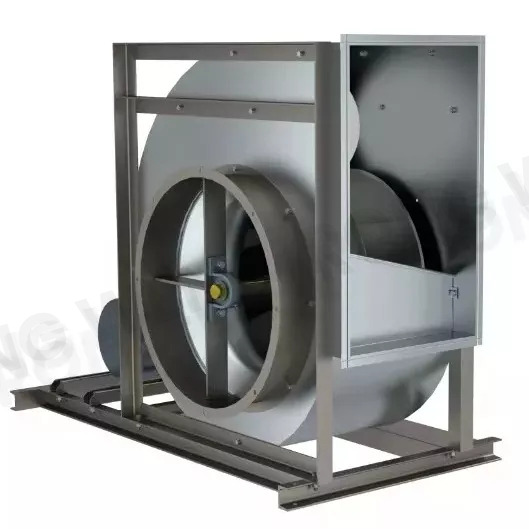
Centrifugal blowers are the undisputed industry standard for commercial culinary applications due to their ability to move air efficiently against high static pressure. However, the internal geometry of the centrifugal wheel radically alters how the equipment handles airborne contaminants.
A Forward Curved centrifugal wheel features numerous small and shallow blades that curve in the direction of the wheel's rotation. Designed to scoop the air, they move high volumes at relatively low rotational speeds. This makes them exceptionally quiet and highly efficient for clean-air HVAC applications. Conversely, in environments dealing with medium to extra-heavy cooking volumes, this design presents critical mechanical vulnerabilities. The cupped shape of the blades acts as a natural trap for sticky particulates. As oils pass through the wheel, they rapidly accumulate within the curve of each blade. A slight imbalance on a spinning wheel generates severe vibration. This vibration translates down the shaft, destroying motor bearings and leading to premature equipment failure.
In contrast, a Backward Inclined centrifugal wheel features fewer, larger, and flatter blades that lean away from the direction of rotation. This geometric configuration provides unparalleled advantages in contaminated environments. The flat design prevents the blades from scooping material. Instead, the centrifugal force generated by the higher rotational speed continuously flings heavier particulates off the blades, granting the wheel a self-cleaning property.
Looking at professional-grade equipment, a specialized backward inclined kitchen fume exhaust fan can effortlessly handle air volumes ranging from 2,000 to over 60,000 cubic meters per hour. They maintain structural integrity even against high total static pressures exceeding 1,500 Pascals. Because they can handle extreme resistance, maintain their balance longer, and resist contaminant accumulation, these robust wheels are universally recognized as the mandatory choice for heavy extraction.
When specifying equipment, the configuration of the housing and the placement of the motor are just as critical as the blade design. Industry codes require restaurant blowers to feature an upblast configuration. This directs the exhausted air vertically into the atmosphere rather than horizontally across the roof. This vertical discharge prevents heavy oils from pooling on the roof membrane and creating secondary fire hazards.
Beyond the housing, the cooking volume heavily influences the choice between belt drive and direct drive configurations. In a belt drive configuration, the motor is mounted in a weather-proof compartment completely outside of the primary airstream. This isolation protects the sensitive electrical windings from temperatures exceeding 300 degrees Fahrenheit and corrosive fats traveling through the duct. Belt drives also allow technicians to easily adjust the airflow by simply changing pulley sizes.
Direct drive systems, where the wheel is mounted directly onto the motor shaft, offer higher energy efficiency due to the lack of friction loss from belts. Historically, standard direct drive motors would be quickly destroyed by hot and contaminated airstreams. Specifically looking at current industry trends, manufacturers are increasingly integrating electronically commutated motors and variable frequency drives into direct-drive units. These modern systems are engineered with totally enclosed motor compartments that physically shield electrical components. This allows them to survive harsh environments while meeting increasingly strict energy efficiency standards.
The selection of your ventilation equipment is intrinsically linked to the ongoing operational maintenance required to keep the facility safe and compliant. National fire safety standards strictly regulate the frequency of maintenance for commercial exhaust systems. This schedule is dictated entirely by the volume and type of effluent produced.
For facilities operating solid fuel appliances, the extreme creosote and ash production mandates a mandatory inspection and professional cleaning every thirty days. High-volume, round-the-clock operations typically require a quarterly cycle. Meanwhile, standard medium-duty kitchens may operate safely on a semi-annual basis.
Because heavy cooking volumes guarantee a frequent and rigorous Cleaning Cycle, the physical construction of the blower must support this process. Facility managers must ensure the unit includes built-in cleanout ports. These ports allow technicians to inspect and pressure-wash the internal wheel without completely dismantling the housing. Heavy-duty hinge kits are also non-negotiable. A hinge kit allows the entire assembly to be safely tilted open, granting access to the vertical ductwork below without physically lifting the heavy housing onto the fragile roof surface.
Even the most robust mechanical systems have a finite operational lifespan when subjected to the corrosive and high-heat environment of commercial cooking. Recognizing the mechanical symptoms of a failing or mismatched unit is crucial for preventing unexpected downtime or dangerous duct fires.
If a facility is currently utilizing equipment that is undersized, several warning signs will manifest. A deafening rattle or structural vibration is a primary indicator that residue has accumulated unevenly on the internal wheel, throwing the shaft out of balance. If kitchen staff report that the hood is no longer effectively capturing smoke, or if facility managers notice oil leaking from the housing down onto the roof structure, the extraction velocity has likely degraded past acceptable safety margins.
Ultimately, upgrading older equipment is also driven by strict new energy efficiency mandates. Outdated blowers struggling against high static pressure draw excessive electrical amperage, significantly driving up utility costs. By replacing an aging and inefficient unit with a correctly sized modern centrifugal system, restaurants can ensure code compliance while simultaneously reducing their baseline electrical consumption.
Selecting the correct mechanical equipment requires a systematic and mathematical approach rather than guesswork. Facility managers and mechanical contractors should follow a rigorous evaluation process to ensure the specified equipment matches the exact operational demands of the kitchen.
Step 1: Calculate Required Airflow Volume
The foundational metric for any ventilation system is the volume of air it must move. Depending on local mechanical codes, the required airflow is determined by measuring the total linear footage of the hood and multiplying it by a specific factor based on the cooking volume. For example, a light-duty oven might only require 150 cubic feet per minute per linear foot. An extra-heavy-duty solid fuel charbroiler may demand upwards of 350 cubic feet per minute per linear foot to safely extract the dense thermal plume.
Step 2: Account for System Static Pressure
Airflow volume alone is insufficient. The blower must be powerful enough to pull that volume of air through physical resistance, known as static pressure. Every component in the system creates resistance. The baffle filters in the hood, the total length of the ductwork, the number of elbow joints, and the specific gravity of the vapor all increase the static pressure. Heavy cooking volumes require highly restrictive and high-efficiency baffle filters. This inherently demands a more robust motor capable of overcoming that resistance without stalling.
Step 3: Consult Specialized Manufacturers
Commercial ventilation is highly specialized. Off-the-shelf HVAC equipment is rarely suitable for high-temperature extraction. It is imperative to source equipment that is specifically engineered, tested, and listed for commercial kitchens. Exploring specialized centrifugal models ensures you acquire equipment built with the precise aerodynamic tolerances, motor enclosures, and structural durability required for your specific operational volume.
Selecting the proper extraction equipment is far from a one-size-fits-all endeavor. The specific grease load generated by your daily menu serves as the foundational metric that dictates everything from the required blade geometry to motor placement and ongoing maintenance schedules. Choosing the right centrifugal design ensures that airborne contaminants are efficiently removed before they can condense into dangerous and flammable deposits.
Investing in the correct ventilation unit upfront prevents costly code violations, drastically reduces fire risks, and ensures a cleaner and safer working environment for your kitchen staff. Take the time to evaluate your current cooking volume, calculate your static pressure, and consult with ventilation specialists. When you are ready to upgrade, explore the high-performance commercial solutions available at centrifugal-fan.com to select the perfect centrifugal system tailored to your facility's unique demands.
Inline duct fans are designed to boost airflow over exceptionally long or complex duct runs, helping to overcome high static pressure. However, they do not filter or reduce airborne fats. Their sole function is to help move contaminated air more effectively to the exterior exhaust unit. If used, inline fans must be specifically rated for high-temperature commercial applications; otherwise, they present a severe fire hazard.
Using a forward curved wheel for a commercial fryer is highly discouraged by ventilation professionals. Fryers produce a heavy volume of vaporized oil that will quickly coat and fill the small, cupped blades of a forward-curved wheel. This rapid accumulation destroys the balance, drastically reduces extraction efficiency, and leads to rapid motor failure. A backward inclined design is strictly required for this application.
Your menu directly dictates your effluent production, which in turn dictates your fire safety compliance schedule. Menus heavy in burgers, fried foods, or solid fuels like wood and charcoal create a massive accumulation rate, typically requiring a professional cleaning every thirty to ninety days. Conversely, a commercial bakery producing minimal airborne oils might only legally require an annual inspection and cleaning.
If a unit is undersized, it will fail to generate sufficient negative pressure to extract the contaminated air. This leads to poor indoor air quality, extreme heat buildup, and smoke spilling into the kitchen and dining areas. More dangerously, the lack of air velocity allows flammable residue to settle and pool heavily on kitchen surfaces and inside the ductwork, creating a high risk of catastrophic duct fires.
Calculating the correct airflow requires evaluating the total linear footage of your exhaust hood and multiplying it by a factor based on your equipment's duty rating. Heavy-duty appliances like woks and gas fryers require significantly higher multipliers than light-duty ovens. Always factor in the additional static pressure created by long duct runs and high-efficiency baffle filters to ensure the fan motor does not stall under heavy loads.
For environments producing heavy vaporized fats, a belt-drive configuration is traditionally preferred. This design isolates the motor outside the contaminated airstream, protecting sensitive electrical components from extreme heat and corrosive oils. However, modern direct-drive fans equipped with specialized enclosures and variable frequency drives are becoming highly popular due to their superior energy efficiency and reduced maintenance requirements.


