
Views: 0 Author: Site Editor Publish Time: 2026-06-28 Origin: Site


In industrial and commercial environments, inefficient air movement creates significant operational hurdles. It leads to compounding energy costs, premature equipment wear, and inconsistent thermal regulation across your facility. Upgrading your airflow infrastructure is rarely just a standard maintenance task. It represents a measurable opportunity to reduce long-term utility expenses and improve system reliability. Outdated equipment silently drains your operational budget while failing to meet modern compliance standards. This guide breaks down the aerodynamic mechanics of axial airflow and compares them against alternative technologies. You will discover an objective evaluation framework designed specifically for facility managers and mechanical engineers. We will explore how optimizing your systems translates directly into sustained energy savings and robust performance. By understanding these underlying mechanics, you can specify the perfect ventilation solution for your unique operating environment.
Volume vs. Pressure: Axial fans are purpose-built to move high volumes of air (CFM) against low static pressure, operating on principles of aerodynamic lift rather than centrifugal force.
Energy ROI: Integrating a high efficiency axial fan with Electronically Commutated (EC) motors can reduce energy consumption by up to 30% compared to legacy AC fan systems.
Application Specificity: They are the optimal choice for cooling towers, heat exchangers, and general facility ventilation, but will underperform in high-resistance ducting systems.
Risk Mitigation: Proper specification requires matching blade pitch, motor efficiency, and acoustic profiles to the specific operational environment to avoid system effect losses.
To understand performance, you must first look at the physics of the blade. Axial Fans do not fling air outward. Instead, their blades act identically to airplane wings. As the central impeller rotates, each blade slices through the air. This rapid movement creates a distinct pressure differential across the airfoil. High pressure builds on one side while low pressure forms on the other. This pressure difference generates aerodynamic lift. The lift forces air to draw in parallel to the central shaft and exhaust directly along that same straight path. This linear trajectory defines the fundamental nature of axial air movement.
This parallel flow path inherently minimizes energy loss. Because the air does not change direction, the motor expends very little energy overcoming internal mechanical resistance. As a result, axial designs deliver exceptional volume. They can move thousands of cubic feet per minute (CFM) using minimal electrical input. However, this efficiency relies entirely on low static pressure. When the system lacks major obstructions, the airflow remains smooth and continuous. If you force an axial unit to push against heavy resistance, the parallel airflow breaks down. The air begins to tumble backward over the blades, destroying the aerodynamic lift and plummeting the fan's efficiency.
Not all impellers perform equally. Manufacturers tweak several specific geometric variables to shift the performance curve. The primary variables include:
Airfoil Shape: A true, teardrop-shaped airfoil cuts through the air cleaner than a flat stamped metal blade, significantly reducing drag.
Chord Width: The distance from the leading edge to the trailing edge of the blade. Wider chords can generate slightly more pressure but may increase motor load.
Pitch Angle: The twist or angle of the blade relative to the airflow. A steeper pitch moves more air per rotation but demands a more powerful motor to prevent aerodynamic stall.
Engineers generally choose between two primary mechanical designs: axial and centrifugal. You must match the architecture to the physical demands of your space.
Axial designs prioritize flow rate. They offer a compact, linear footprint. You can mount them directly inside a tube, across a wall opening, or seamlessly within a ceiling plenum. They excel when you need to move a massive amount of air quickly.
Centrifugal designs prioritize pressure. They pull air into the center of a housing and use centrifugal force to throw it outward at a 90-degree angle. This right-angle turn allows the fan to generate immense static pressure, making it ideal for pushing air through dense filters or miles of complex ductwork. However, this design sacrifices flow volume and requires a much larger, heavier physical footprint.
| Feature | Axial Architecture | Centrifugal Architecture |
|---|---|---|
| Airflow Volume (CFM) | Very High | Moderate to Low |
| Static Pressure | Low (Typically under 2" WG) | High (Can exceed 10" WG) |
| Flow Direction | Straight-through (Parallel) | 90-degree turn (Perpendicular) |
| Physical Footprint | Compact, inline | Bulky, requires scroll housing |
Axial units dominate specific applications. They are the undeniable champions for general factory exhaust systems. When you need to clear fumes from a massive warehouse, their high-volume capacity is unmatched. They also excel in condenser cooling applications. Heat exchangers and cooling towers require immense, steady breezes to strip heat away from coils. Furthermore, localized spot cooling heavily relies on this technology. Pointing a large axial blower at a hot manufacturing process cools the equipment rapidly and efficiently.
You must acknowledge the mechanical limitations. Axial technology is the wrong choice for high-resistance environments. Avoid specifying them for complex ducting systems featuring multiple sharp bends. They cannot handle heavily filtered systems, such as HEPA-grade cleanrooms. The dense filter media creates immense backpressure. If you install an axial unit here, the motor will overwork, the blades will stall, and airflow will drop to near zero. Always verify your system's total static pressure before making a final selection.
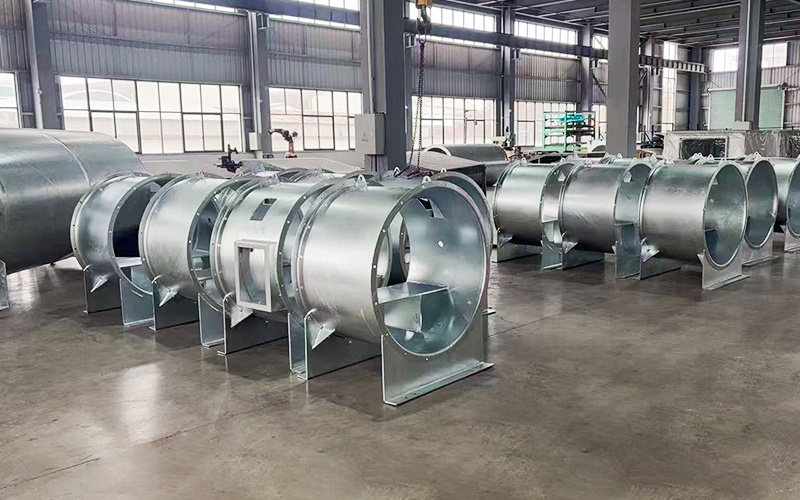
The motor dictates the long-term energy consumption of your system. Historically, facilities relied on alternating current (AC) motors. These legacy motors run efficiently only at full speed. When you try to slow them down, they waste enormous amounts of electrical energy as heat. Upgrading to a High Efficiency Axial Fan equipped with an Electronically Commutated (EC) motor changes the equation entirely. EC motors use onboard electronics to actively manage the magnetic field. This allows for precise, infinite speed control. You can run the fan at 50% speed and effectively use only a fraction of the power, maintaining peak efficiency across all partial load conditions.
Blade material dramatically impacts performance and longevity. You must select the material based on your specific environmental hazards.
Glass-reinforced polyamide: This composite plastic is incredibly lightweight. It reduces the starting torque required by the motor. It resists moisture perfectly, making it ideal for standard HVAC and cooling tower applications.
Cast aluminum: Aluminum blades withstand extreme temperatures. If your exhaust system pulls hot, abrasive air from an industrial oven, aluminum will not warp or degrade over time.
Stainless steel: Used primarily in highly corrosive environments or food-grade processing facilities where harsh chemical washdowns occur regularly.
Fixed pitch blades are cast as a single solid piece. They offer rigid durability but zero flexibility. If your facility expands and requires 20% more airflow, a fixed pitch fan cannot adapt. You must buy an entirely new unit. Adjustable pitch blades solve this problem. The individual blades bolt into a central hub. If facility requirements change, a technician can manually loosen the bolts and twist the blades to a steeper angle. This future-proofs your investment. You can easily alter the performance characteristics without undergoing a complete system replacement.
Never rely solely on marketing brochures for performance data. You must verify that the manufacturer's claims match reality. Look for certifications from trusted regulatory bodies. The Air Movement and Control Association (AMCA) is the gold standard for fan testing. An AMCA-certified rating guarantees that the fan will deliver the exact CFM and acoustic levels promised. Similarly, ISO certifications indicate strict manufacturing quality control. Demanding these certifications protects your facility from underperforming equipment and inflated efficiency claims.
Lowering your wattage per CFM translates directly to reduced utility bills. When you upgrade from an inefficient AC system to a modern EC-driven axial unit, the electrical draw drops significantly. To understand the financial impact, engineers often use a straightforward return on investment (ROI) calculation framework. You can follow these steps to project your own savings:
Establish the Baseline: Calculate your current fan's power consumption. Multiply its operating wattage by the hours it runs annually.
Determine the Utility Rate: Find your exact commercial cost per kilowatt-hour (kWh).
Calculate Current Costs: Multiply the annual energy consumption by your utility rate to find your current annual expense.
Project the Upgrade: Use the manufacturer's data for the new efficient fan to find its projected operating wattage.
Compare and Assess: Subtract the projected cost from your current cost. Divide the initial purchase price of the new fan by these annual savings to determine your exact payback period in years.
Efficiency goes beyond just electrical consumption. It also involves physical space and installation labor. Because these units move air in a straight line, they boast an incredibly compact physical footprint. You can install them directly into exterior walls or drop-ceilings. They slip easily into existing short-duct runs. You do not need to build large, reinforced concrete pads to hold bulky scroll housings. This straightforward installation saves thousands of dollars in structural modification costs. It reduces facility downtime during retrofits and simplifies the overall mechanical layout of the building.
Noise is a direct byproduct of mechanical and aerodynamic inefficiency. When a blade creates turbulence, it wastes energy and generates loud, low-frequency sound. Modern swept-blade designs solve this issue. By mimicking the curved wings of an owl, these blades slice the air gradually rather than slapping it all at once. This significantly reduces turbulence. The resulting drop in operational noise improves workplace safety. It helps facilities maintain strict OSHA compliance regarding occupational noise exposure. Employees experience less auditory fatigue, and the surrounding neighborhood avoids disruptive industrial humming.
Even the best equipment fails if installed poorly. The "System Effect" is the most common installation failure. An axial unit needs clean, undisturbed air entering and exiting the blades. If you place the unit too close to a sharp duct bend, a heavy cooling coil, or a poorly designed damper, you destroy the efficiency curve. The obstruction creates turbulent, spinning air. This turbulence induces aerodynamic stall. The fan spins at full speed, draws maximum power, but moves a fraction of the intended air. Always adhere to AMCA guidelines for minimum straight-duct clearances before and after the fan.
Airborne particulates pose a constant threat to efficiency. Dust, grease, and manufacturing debris inevitably stick to the blades over time. This buildup alters the delicate airfoil shape. A dirty blade loses its aerodynamic lift and forces the motor to work harder. You must plan for regular maintenance. Ensure your installation includes sufficient clearance for technicians to access the motor housing and clean the impeller. Installing inspection doors in the ductwork immediately adjacent to the fan is a best practice. Neglecting blade cleanliness will degrade efficiency steadily year after year.
High-speed rotating equipment generates vibration. If you rigidly bolt the housing directly to the building structure, this vibration travels through the walls. Over time, it loosens fasteners and degrades the fan's internal bearings. You must install proper mounting isolators. Spring isolators or heavy-duty rubber mounts absorb this kinetic energy. Furthermore, ensure the impeller is dynamically balanced at the factory. An unbalanced blade wobbles slightly at high speeds. This wobble creates excessive noise and guarantees premature bearing failure, leading to unexpected catastrophic breakdowns.
Airflow efficiency is ultimately a product of matching the right tool to the right pressure environment. You cannot force a low-pressure device to perform well in a high-resistance duct system. By understanding the aerodynamic principles of lift and the variables of blade design, you protect your facility from costly specification errors. When requesting quotes, urge your decision-makers to prioritize the required CFM, the system's exact static pressure, and modern motor efficiency standards over purely lowest-initial-cost options. Upgrading your infrastructure requires precise evaluation, but the operational savings are highly predictable. As a practical next step, audit your current static pressure requirements. Consult an application engineer to model the projected energy savings of an upgrade, and start eliminating the hidden utility drains within your facility today.
A: Yes, but only in short, straight duct runs with low static pressure (typically under 1 to 2 inches of water gauge). Tube-axial or vane-axial variants are best for these scenarios. They will stall if pushed against heavy resistance.
A: EC motors use built-in electronics to control the magnetic field, eliminating friction-prone brushes. This allows the fan to slow down or speed up with near-zero energy waste, unlike traditional AC motors that burn excess energy as heat when operating below full speed.
A: Efficiency is generally calculated using the formula: (CFM × Static Pressure) / (Wattage input). Comparing this baseline against manufacturer curves for modern units reveals the exact potential for long-term operational energy savings.


